Witt Solitaire - Card Games
- 4.6
- Rating
- 500.00K
- Installs
- Free
- Price
 Analysis by App-foxy
I found Witt Solitaire - Card Games easy to understand from the moment I opened it. It is a free board game from Funjoy Island built around the familiar solitaire format, so the basic idea is immediately recognizable: arrange cards in the right order, clear the layout, and make the best use of every available move. That familiarity is its biggest advantage for a first-time player, because I did not need a long tutorial or a complicated set of rules before starting.
The game is aimed at people who want a quiet card game rather than a busy multiplayer experience. I can see it fitting naturally into a short break, a commute, or the few minutes before bed. It is also suitable for Everyone, which makes the presentation approachable for a broad audience. The store summary places it among classic solitaire games, and that is the right expectation: this is a straightforward card-playing experience, not a large adventure game with a story, characters, or a demanding progression system.
Getting Comfortable with Witt Solitaire
I focus here on the small choices that make a first round feel manageable, rather than treating every move as a test. I’ve found it reassuring to aim first for a clearer board, not a perfect run: each newly exposed card gives me more information for the next decision. Once that rhythm feels natural, it is easier to spot which habits are helping and where a different move might open the layout.
You May Also Like

 Blood Strike: 2.5 Anniversary
Blood Strike’s Loadouts Turn Every Drop Into a Tactical Gamble
A close look at Blood Strike’s custom loadouts: how fast access to signature weapons reshapes its battle royale rhythm, rewards preparation, and narrows the gap between fights.

 Pandora - Music & Podcasts
Pandora’s Music Is Easy to Start, but Harder to Recover
Pandora’s strength is its low-effort path from a seed to a station. Its weak spot is how much confidence it asks you to place in connection, setup, and quiet recovery.

 8 Ball Pool
 Is Built on Rivalries, Rematches, and Routine
A close look at the rivalries, rematches, shared routines, and unanswered safety questions that turn a quick pool match into a persistent mobile community.

 Samsung Music
’s Quiet Strength Is Playing What You Already Own
Its reach comes less from spectacle than from dependable access to a personal library. That simplicity is both the app’s strongest retention engine and its ceiling.

 AccuWeather: Weather Radar
AccuWeather Review: A Quick, Clear Forecast for Everyday Decisions
For everyday plans, the best forecast is the one you can understand quickly. AccuWeather makes rain timing, radar, and local conditions easy to act on, with a few trade-offs.

 Hill Climb Racing
Why Hill Climb Racing Still Turns Crashes Into One More Run
A tiny car, a bumpy hill and one more upgrade: Hill Climb Racing keeps resurfacing because its simple chaos makes every near-miss feel personal.
More From Our News Desk



What the first launch feels like
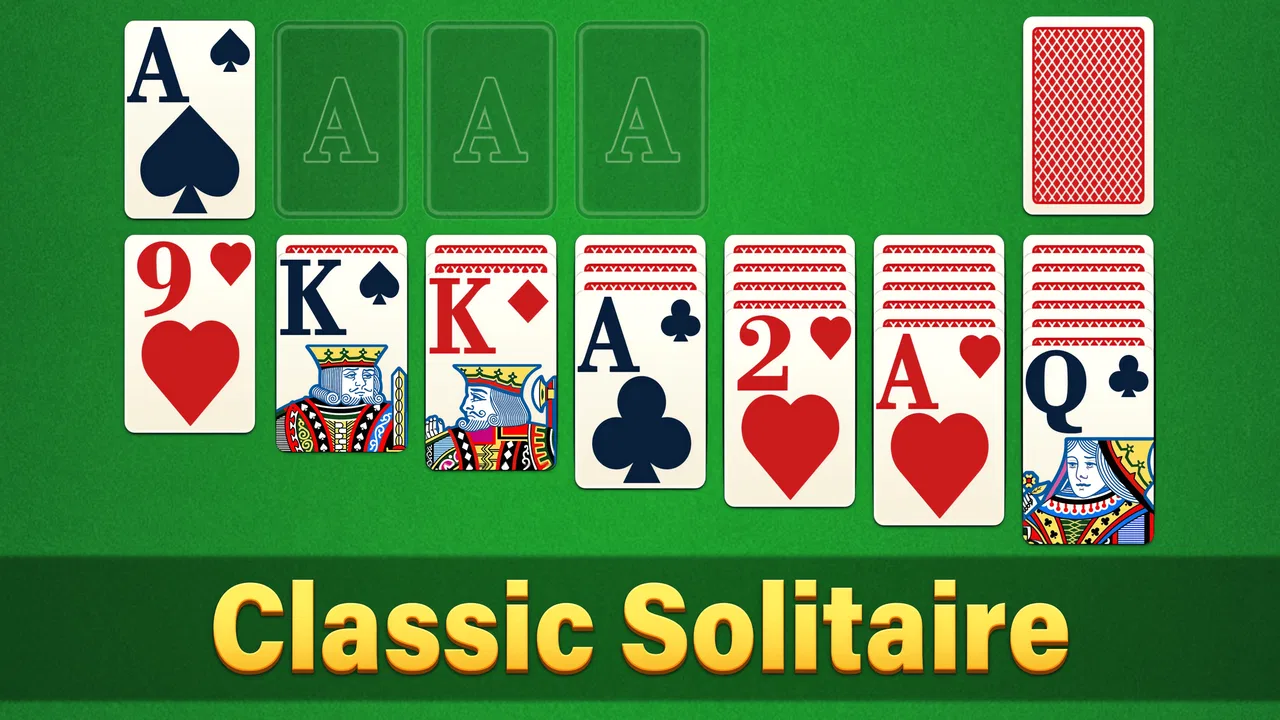
My first useful impression was that the game does not ask me to learn an unfamiliar card system. The value is in recognizing the board and then making careful decisions. If you have played a traditional solitaire game with cards arranged in columns, you will probably understand the purpose of the main screen quickly. If you have not, the best approach is to pause for a moment and identify which cards are face up, which cards are hidden, and where completed sequences are meant to go.
That small pause matters. New players often start moving cards immediately and then become confused when a move is unavailable. Solitaire is not only about finding a legal move; it is also about revealing hidden cards and preserving options for later. I recommend treating the first few turns as an inspection phase. Look for moves that uncover a face-down card before making a move that merely changes the position of cards you can already see.
The game’s simple presentation works well for this style of play. There are fewer distractions when the board is easy to read, and that helps me focus on the order of the cards rather than on decoration. The trade-off is that players who expect animated events, collectible themes, or a large selection of modes may find the experience restrained. Its appeal comes from the card puzzle itself.
A practical first setup
Before starting seriously, I suggest checking that the cards are comfortable to read on your phone. A smaller screen can make a solitaire layout feel crowded, especially when several columns overlap. Holding the device in the position that gives you the clearest view is more useful than rushing into the first deal. If a card looks easy to miss beneath another, slow down and tap deliberately rather than relying on hurried gestures.
The game runs on Android devices using version 6.0 or later, so it is accessible on a wide range of phones. That broad compatibility is helpful if you are using an older spare device for casual games. I would still judge the experience by the screen you actually have: a larger display makes overlapping columns easier to inspect, while a compact phone may require more careful tapping.
There is no need to approach the first round as a test of skill. I treat an opening deal as a way to learn the spacing, card movement, and rhythm of the board. If I lose, I can still learn which choices created a dead end. That mindset is especially useful here because the familiar rules can make a new player overconfident. Knowing what a legal move looks like is different from knowing which legal move is strategically best.
How to reach the first meaningful success
For a first win, I recommend using a simple priority order. First, look for moves that expose hidden cards. Second, check whether a move creates an empty column that can accept a useful card sequence. Third, consider whether moving a visible card will block a lower card that you may need soon. This approach is more reliable than automatically moving every available card to a foundation as soon as possible.
One of the most useful habits I developed was to avoid filling an empty column without a reason. An empty space can be valuable because it gives you room to move a longer sequence, but placing the wrong card there can remove that flexibility. If you have a choice between two legal moves, prefer the one that reveals information or keeps more future moves open. That is the difference between simply playing cards and solving the layout.
Another helpful technique is to count backward from the cards you need. When you are trying to build a foundation, do not look only for the next card in sequence. Notice which column currently hides it, and ask whether moving another stack will expose it. This prevents a common beginner mistake: making a move that looks productive but leaves the needed card trapped under an arrangement you can no longer rearrange.
My first meaningful success would not necessarily be completing an entire round immediately. It could be clearing a column, exposing several hidden cards, or recovering from a difficult-looking position. Those smaller milestones show that the decisions are beginning to make sense. Once the board stops feeling like a collection of random cards and starts feeling like a set of connected choices, the game becomes much more satisfying.
Confusing moments new players should expect
The most common confusion is assuming that every visible move is equally good. Solitaire usually presents several legal actions, but those actions do not have the same value. Moving a card because it can move may leave fewer options than waiting and using another card first. When I get stuck, I review the last few decisions instead of blaming the deal immediately.
It is also easy to focus too much on the foundation piles. Building them is the eventual goal, but the tableau is where most of the important decisions happen. Sometimes keeping a card in a column is better than sending it upward at once, particularly when that card is helping you move a hidden sequence. A useful rule is to ask, “Does this move reveal something or improve my space?” If the answer is no, I consider whether it is better to wait.
Players can also misread a blocked layout as a complete failure. Before abandoning a round, I scan every column from top to bottom and check whether a sequence can be moved as a unit. I then look for a card that can be placed into an empty space or moved onto a compatible card. This second inspection often finds an option that was overlooked during the first, faster pass.
The game is best enjoyed with patience, but that does not mean every round deserves unlimited effort. If I have reached a position with no useful rearrangement and no realistic route to uncovering a needed card, restarting is sensible. The lesson is to identify why the layout failed rather than repeating the same opening pattern. That gives the next attempt a purpose.
Everyday use: a short break without losing focus
I can imagine using this game during a ten-minute waiting period when I want something more engaging than scrolling but less demanding than a competitive game. A single solitaire round gives me a clear task with a natural stopping point. I can concentrate on the current layout, then put the phone away without needing to remember a team, a story mission, or a long chain of objectives.
That makes it a good match for players who enjoy quiet concentration. It can also work as a small mental reset after repetitive work: the rules are familiar, but the arrangement forces me to examine choices. I would not describe it as a deep strategy game in the same way as a complex board title, yet it rewards planning more than its simple appearance might suggest.
There is a trade-off in that simplicity. If you want social competition, live opponents, or a rich collection of card variants, this may feel too narrow. A dedicated multiplayer card app would be a better choice for direct competition, while a larger board-game collection would offer more variety in one installation. Witt Solitaire makes more sense when you specifically want solitaire and do not want extra systems getting in the way.
Small techniques that improve the experience
I found three habits particularly useful. The first is to scan for hidden-card opportunities before touching the foundation piles. This keeps the board flexible and increases the information available to me. The second is to preserve an empty column until I know which sequence will benefit from it. Space is not just a vacancy; it is a resource that can change the entire layout.
The third is to delay automatic-looking decisions. If two cards can be moved, I compare what each move exposes and what each one blocks. This takes only a few seconds, but it reduces the number of self-created dead ends. It is especially valuable when playing quickly during a break, because speed encourages the most obvious move rather than the most useful one.
I also recommend using a deliberate rhythm: scan, choose, move, scan again. Rapid tapping makes it easier to overlook a newly available card or misunderstand the relationship between overlapping columns. The slower rhythm may sound minor, but it turns the game from trial and error into a more controlled puzzle. That is where the strongest part of the experience lies.
Who will enjoy it, and who should skip it
This game suits someone who wants a familiar card puzzle that can be picked up without preparation. It is a sensible choice for casual players, older Android users, and anyone who likes arranging cards while thinking through consequences. The free price also removes the need to make a financial commitment before deciding whether the basic solitaire loop fits your habits.
The audience is not limited to beginners. Experienced solitaire players may appreciate having a focused option for quick rounds, especially when they do not want a broader game with multiple distractions. At the same time, experts looking for unusual rule sets or a highly competitive challenge may prefer a more specialized alternative. The straightforward format is welcoming, but it may not provide enough novelty for players who have already exhausted classic solitaire.
I would also skip it if my main goal were constant rewards, social interaction, or a large progression system. Nothing about the core identity suggests that those elements are the reason to install it. Its strength is the opposite: a compact board, recognizable card logic, and room to make decisions at my own pace.
How it compares with familiar alternatives
Compared with playing physical solitaire, the app is more convenient because the cards are always ready and the layout can be reset without gathering a deck. The physical version still has a tactile quality that a phone cannot reproduce, and some players will prefer the slower, hands-on process. Witt Solitaire wins on portability and speed, while a real deck wins on atmosphere.
Compared with a general card-game collection, this title is more focused. That focus can be refreshing when I already know I want solitaire, but it also means less variety from one session to the next. Compared with a competitive card game, it is calmer and more private. There is no pressure from another player’s turn, yet there is also no social tension or shared sense of achievement.
The right choice depends on what I want from the moment. For a quick solo puzzle, this game is more direct than a large board-game app. For variety, competition, or deeper customization, another category of app may serve me better. I would choose Witt Solitaire when the classic card layout itself is the attraction.
What the current release means for a new player
The current version is 3.10.3, and the game has been available since November 24, 2023. Its presence on the store is substantial, with more than 500 thousand installs, an average rating of 4.6 from about 6.9 thousand ratings, and roughly 1 thousand written reviews. Those figures suggest that many players have found the basic experience worthwhile, while the written feedback can still be useful for spotting whether the style matches your preferences.
I would not use popularity as a substitute for personal fit. A well-liked solitaire game can still feel too plain if you want constant novelty, and a simple layout can be exactly right if you want a dependable way to pass a few minutes. The important question is whether you enjoy making careful card decisions without needing a larger reward structure around them.
My recommendation after using it
Witt Solitaire - Card Games is at its best as a calm, accessible solo card puzzle. I like that a first-time player can understand the objective quickly, yet the game still rewards restraint, planning, and attention to the order of moves. The most satisfying moments come from uncovering a blocked card or rescuing a layout through a move that was easy to miss.
Its limitations are equally clear: the focused classic-card approach will not satisfy everyone, and players seeking multiplayer action or a broad catalogue of modes should look elsewhere. For me, that simplicity is not a flaw when I want a short, familiar challenge. I would recommend trying it if you want a free solitaire game for Android, especially on a device running Android 6.0 or later and with a screen large enough to read overlapping cards comfortably.
My advice is to give the first round time, prioritize hidden cards, protect empty columns, and judge each move by the options it creates rather than by how quickly it moves a card upward. Follow that path and the game becomes more than a basic time-filler. It becomes a small daily puzzle that is easy to start, difficult enough to keep your attention, and simple to leave whenever your break is over.
FAQs for Witt Solitaire - Card Games
01What is Witt Solitaire - Card Games and how does it differ from other solitaire apps?
Witt Solitaire - Card Games is a modern take on the classic solitaire experience, offering a variety of solitaire variations with unique themes and challenges. Unlike other apps, it focuses on user-friendly interfaces and daily challenges to keep gameplay fresh and engaging. It provides both classic and innovative solitaire modes, making it suitable for both traditionalists and those seeking a new twist.
02Is Witt Solitaire - Card Games free to download and play?
Yes, Witt Solitaire - Card Games is free to download on both Android and iOS platforms. While the game offers in-app purchases for additional features or to remove ads, these purchases are optional. The free version provides a comprehensive solitaire experience with numerous levels and challenges.
03Does Witt Solitaire - Card Games require an internet connection?
Witt Solitaire - Card Games can be played offline, making it an excellent choice for users who want to enjoy solitaire without needing an internet connection. However, some features, such as daily challenges or leaderboard updates, may require online access to function fully.
04Are there any in-app purchases or ads in Witt Solitaire - Card Games?
Witt Solitaire - Card Games includes in-app purchases that allow users to buy additional card themes, hints, or to remove ads. While ads are present in the free version, they are not overly intrusive and can be removed with a one-time purchase. These features enhance the gaming experience but are not necessary to enjoy the core gameplay.
05What accessibility options are available in Witt Solitaire - Card Games?
Witt Solitaire - Card Games includes several accessibility options to cater to a wide range of players. These include adjustable text sizes, colorblind modes, and intuitive touch controls. The app is designed to be easy to navigate, ensuring that players of all abilities can enjoy a seamless and enjoyable gaming experience.
Pros
- Intuitive interface for easy navigation.
- Variety of solitaire game modes available.
- Smooth animations enhance gameplay experience.
- Minimalistic design reduces visual clutter.
- Offline mode for playing anywhere.
Cons
- Ads can be intrusive during gameplay.
- Limited customization options for themes.
- Occasional lag on older devices.
- In-app purchases can be pricey.
- No multiplayer or social features.

Witt Solitaire - Card Games
Gallery